The quality control challenge.
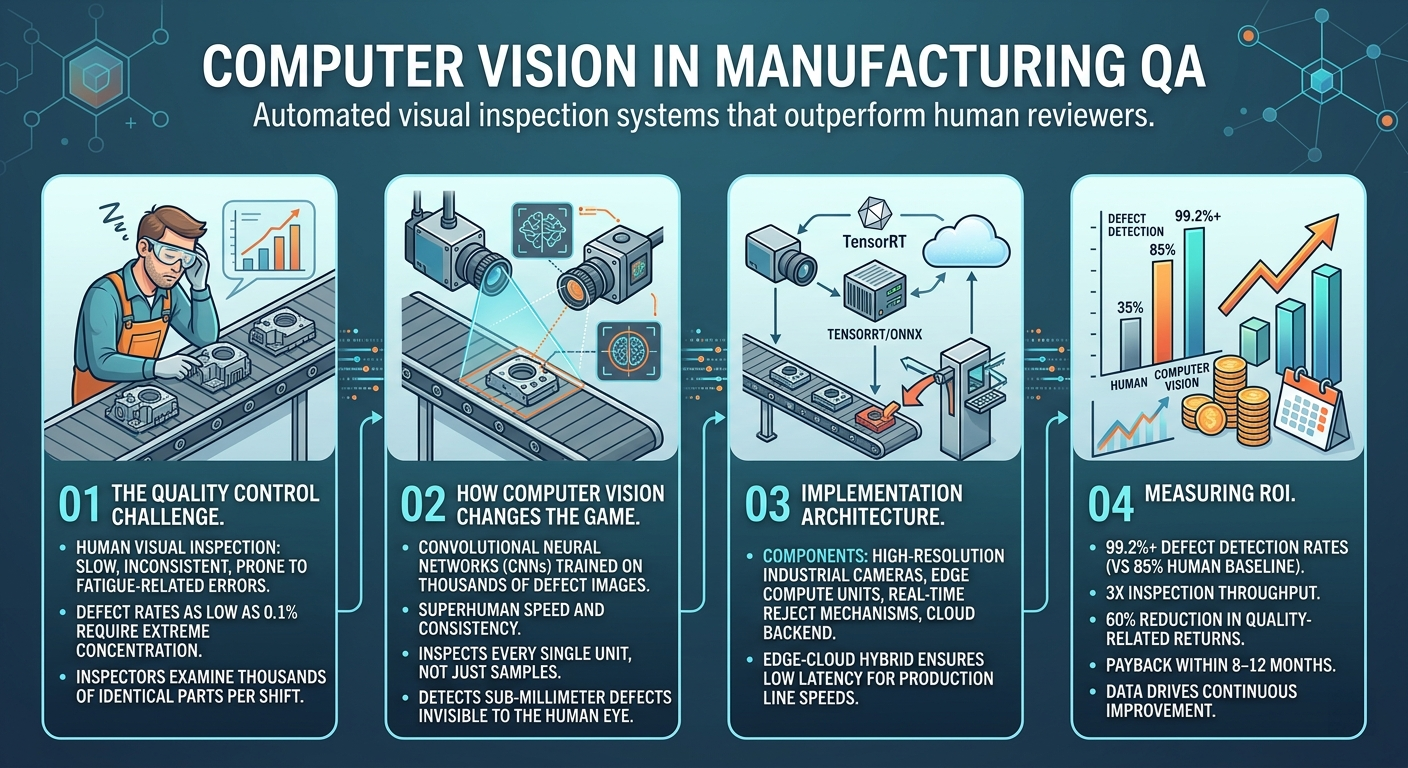
Manufacturing quality inspection has traditionally relied on human visual inspection — a process that is slow, inconsistent, and prone to fatigue-related errors. With defect rates as low as 0.1%, inspectors must maintain concentration while examining thousands of identical parts per shift.
How computer vision changes the game.
Modern computer vision systems use convolutional neural networks trained on thousands of defect images to detect anomalies at superhuman speed and consistency. These systems inspect every single unit — not just samples — and can detect sub-millimeter defects invisible to the human eye.
Implementation architecture.
A typical deployment includes high-resolution industrial cameras, edge compute units running optimised inference models (TensorRT/ONNX), real-time reject mechanisms, and a cloud backend for model retraining and analytics. The edge-cloud hybrid ensures low latency for production line speeds.
Measuring ROI.
Our manufacturing clients typically see 99.2%+ defect detection rates (vs 85% human baseline), 3× inspection throughput, 60% reduction in quality-related returns, and payback within 8–12 months. The data generated also feeds continuous improvement of manufacturing processes.